The Numbers Don’t Lie, But They Tell a Strange Story
Here’s something that should make every engineering manager do a double-take: GitHub’s Copilot Workspace, fresh out of private beta as of December 2025, is making developers 40% slower at complex refactoring tasks. Yes, you read that right. Despite achieving an impressive 85% accuracy in code generation, teams are moving like they’re coding through molasses.

This isn’t an isolated quirk. The JetBrains Developer Ecosystem Survey 2026 reveals that teams using AI coding assistants are spending 60% more time in code review cycles compared to traditional workflows. Meanwhile, Microsoft’s internal analysis of 2,400 developers shows a 34% increase in technical debt accumulation over six-month periods when AI assistance is heavily utilized.
If you’re thinking this sounds backwards, welcome to the club. We’re living through the most counterintuitive productivity paradox since someone decided standups should last longer than actual coding sessions.
The Hidden Tax of Generated Code
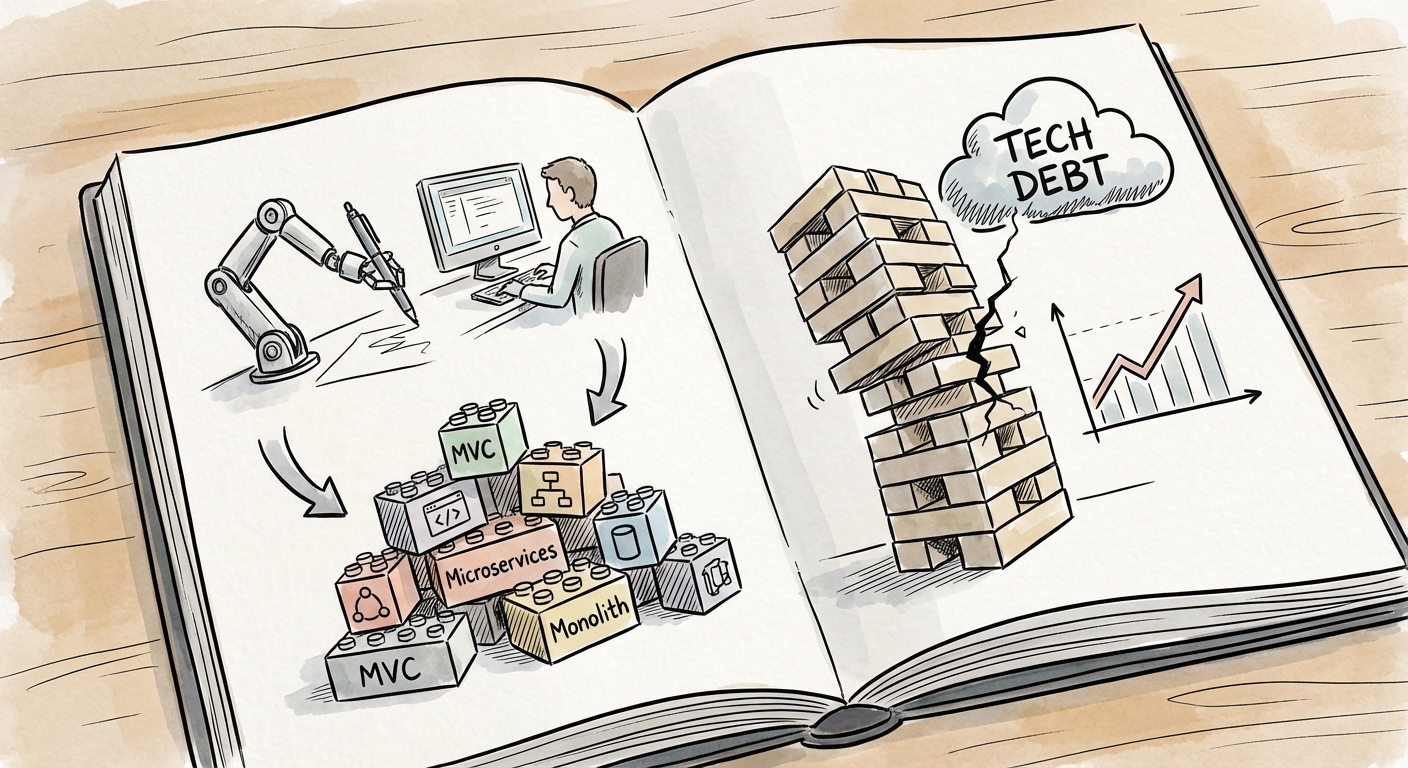
The core issue isn’t that AI writes bad code. It’s that AI writes code that looks deceptively good on first glance but introduces subtle inconsistencies that compound over time. Think of it as the coding equivalent of those IKEA instructions that seem straightforward until you realize you’ve been assembling the bookshelf upside down for three hours.
Microsoft’s study found that AI-generated code tends to follow inconsistent architectural patterns within the same codebase. One module might use dependency injection while another hardcodes connections. The AI isn’t maintaining the conceptual integrity that experienced developers naturally preserve. Each generated snippet is locally optimal but globally chaotic.
The Sourcegraph Code Intelligence Report tracked a 15% increase in bug reports across 450 enterprise customers with high AI code generation usage. These weren’t syntax errors or obvious mistakes that would fail CI. They were subtle logic errors, edge case mishandlings, and integration issues that only surfaced in production or during complex feature additions.
The Code Review Bottleneck Nobody Saw Coming
Here’s where things get really interesting. That 60% increase in code review time isn’t because developers are being more thorough. It’s because reviewing AI-generated code requires a fundamentally different cognitive approach than reviewing human-written code.
When I review code written by a colleague, I can usually predict their thought process. I know Sarah tends to over-engineer error handling, and Jake always forgets edge cases in date parsing. With AI-generated code, there’s no mental model to work with. Every line needs individual evaluation because the AI doesn’t have consistent blind spots or reliable strengths.
The result is a review process that feels like archaeological work. You’re not just checking for correctness. You’re reverse-engineering the intent behind each generated block to ensure it aligns with the broader system design. It’s exhausting in a way that traditional code review simply isn’t.
The Learning Curve Flattening Effect
Stack Overflow’s latest developer satisfaction scores dropped 12 points for teams heavily reliant on AI coding tools. The primary complaint? Decreased learning opportunities and genuine skill atrophy concerns. This resonates with anyone who’s watched junior developers lean too heavily on AI assistance during their first year.
There’s a subtle but crucial difference between using AI as a productivity multiplier and using it as a cognitive crutch. The former requires you to understand what you’re asking for and why. The latter creates a dependency where you lose the ability to reason through problems independently.
I’ve seen senior developers who can prompt-engineer circles around anyone but struggle to implement a simple algorithm without AI assistance. It’s like being an expert at using GPS but unable to read a paper map. The tool becomes so central to the process that removing it reveals gaps you didn’t know existed.
Finding the Sweet Spot
The productivity paradox isn’t an indictment of AI tools. It’s a sign that we’re still figuring out how to use them effectively. The teams that buck these trends share a few common practices: they use AI for boilerplate generation and initial scaffolding but rely on human judgment for architectural decisions and complex logic.
They also invest heavily in code review tooling that can catch the subtle inconsistencies AI tends to introduce. Static analysis tools configured to enforce architectural patterns become essential. Think of it as automated quality gates that ensure AI-generated code follows human-defined standards.
The most successful implementations I’ve observed treat AI coding assistants like incredibly fast junior developers. You wouldn’t let a junior developer merge code without thorough review, and the same principle applies here. The difference is that this “junior developer” can write thousands of lines per day, making the review bottleneck even more important to address.
What’s your experience with AI coding tools? Are you seeing similar productivity paradoxes in your team, or have you found ways to harness the benefits without the hidden costs? I’d love to hear about the patterns you’ve discovered, especially if you’ve managed to thread the needle between AI efficiency and code quality.